

Index Returns
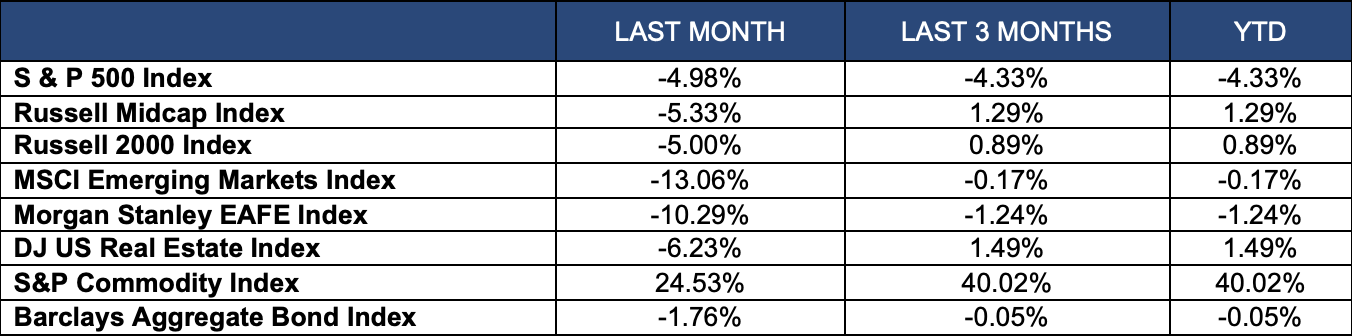
The conflict in the Middle East rattled most markets in March as investors feared rising oil prices and a corresponding drop in consumer spending. Prior to the conflict, the markets were moving nicely. The S&P 500 dropped 4.98% in March and ended the quarter down over 4%. The Russell Midcap Index declined by more than 5% in March but is positive on the year. The Russell 2000 Index (Small Cap Stocks) also dropped by 5% in March but is still holding on to gains for the year. Gold advanced in the first quarter by about 3% while silver posted slightly better results. Bitcoin and other crypto currencies declined by more than 20%.
International stocks had some big swings once the crisis began. The MSCI EAFE Index lost 10% in March but is only down 1% on the year. Emerging Markets dropped by more than 13% in March and yet the index is roughly flat on the year. Brazil’s market has led the way by advancing almost 19% so far in 2026.
Bonds had a rough month with policy uncertainty and have now lost all their gains for the year. The Barclays Aggregate Bond Index is down 0.05%. The global bond market declined by nearly 2% in the first quarter. We don’t see a lot of movement in rates for 2026, so most of the return this year will come from interest.
Economic Review and Outlook
The economy was pretty solid prior to the conflict escalation in the Middle East. Gross Domestic Product (GDP) grew by an annualized rate of 4.4% in the third quarter but slowed to 0.5% in the fourth. Early projections are still showing positive for the first quarter of 2026, and the outlook for now also looks favorable for Q2.
The higher tax refunds, expected from the One Big Beautiful Bill, will now likely be consumed by higher gas prices. Lower income households are more impacted by higher gas prices than higher income households due to the percentage of the household budget that gas utilizes. It seems likely that Congress will come up with some additional stimulus later in the year to help offset the pain at the pump.
The Federal Reserve has a dual mandate: employment and inflation. The unemployment rate is at 4.3%, which is near full employment. The CPI inflation index came 2.4% in February and 3.3% in March. These are still not far from their target of 2.0% inflation. The recent uptick in energy prices could stretch the CPI higher. We do think that this number will then slowly move back down to the 2.4% range by the end of the year. This means that the Federal Reserve is likely to hold rates steady until the end of 2026.
The Leading Economic Index decreased by 0.1% in January to 97.5 following a 0.2% drop in December. Industrial Production increased 0.2% in February after increasing 0.7% in January. The Capacity Utilization Rate (which measures how much slack is in the economy) was at 76.3% in February.
Non-farm payrolls rose by 178,000 in March and the unemployment rate remained at 4.3%. Weekly unemployment claims were 219,000 for the week ending April 4, 2026. The 4-week moving average is at 209,500. There are 6.8 million job openings in the U.S. It is important to remember that the unemployment rate is a lagging indicator. We are very much in a slow to hire and slow to fire labor market. Although a weaker economy typically triggers a higher unemployment rate, the massive drop in immigration may keep the labor force thin causing the rate to hold steady.
Manufacturing registered 52.7% on the ISM PMI Index in March. This indicator remains in expansion territory for the 17th month in a row. The New Orders Index came in at 53.5% which marks the third month in a row of growth. The ISM Services Index was at 54.0% in March, which was down 2.1% from February. The Business Activity Index came in at 53.9% which is the lowest reading since September. New Orders for the service sector came in at 60.6% which was 2 percentage points higher than February.
Consumer spending will continue to be a topic of conversation for economists as they work through the higher energy costs associated with the Middle East conflict. Lower income households will have to curb their spending, while higher income households will need to continue to spend to offset any disruptions. The increase in net worth for many households over the last two years should help keep the economy going for at least this year.
Equity and Bond Markets
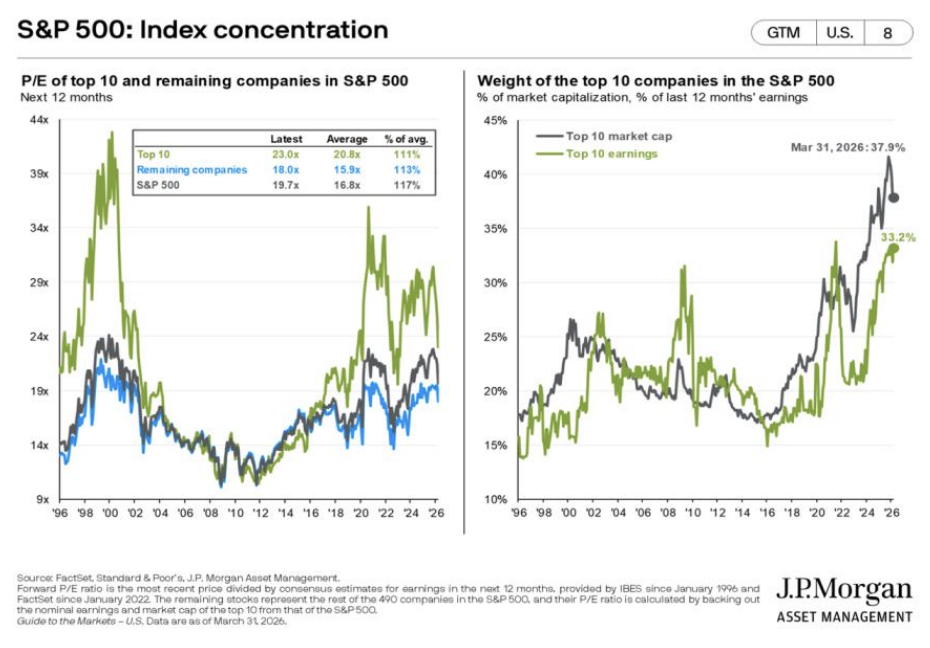
We mentioned in the last newsletter that we were seeing a shift in domestic equity performance from the mega large cap growth sector to more value-oriented companies. This rotation in performance was enhanced in March as the top 10 stocks in the S&P 500 saw significant contractions while value companies held up relatively well. The S&P 500 growth index dropped 8% in the quarter while the S&P 500 value index was flat.
The good news is that this correction has improved overall valuations across the board here in the U.S. The left chart below shows that the top 10 companies in the S&P 500 saw an improvement in their P/E ratio from more than 30 down to 23 times earnings. The remaining companies in the index now have a P/E ratio of only 18 times earnings.
International equities continue to look attractive. Japan, Europe, Emerging Markets and China are all trading near their long-term averages from a P/E perspective. If the Federal Reserve does not raise rates or even makes a cut later this year and Central Banks around the globe increase their rates, the U.S. Dollar will decline in value. If this occurs, it will be another tailwind for international investments.
We think bond prices will hold relatively stable for the remainder of this year as we are not expecting any moves from the Fed until November. Meanwhile, coupon rates are solid, so bonds still offer an attractive yield and provide diversification benefits to offset the volatility of equities.
Portfolio Management
The Investment Committee continues to monitor the economy, the market, and the portfolio allocations. Our strategy has not changed. We expect continued volatility in the market as we navigate the oil disruptions in the Middle East. We still believe that some domestic large cap growth sectors are extended and that value stocks remain attractive.
We will continue to look at ways to diversify the portfolio to try to minimize the downside capture ratio. We are looking at ways to increase the yield of the portfolio while maintaining appropriate risk. It will be important to have allocation discussion with your planner to make sure that your particular allocation matches your investment risk and time horizon.
After three years of double-digit returns, we do expect continued downside volatility. Maintaining an appropriate allocation and diversification will be critical to portfolio performance. While nobody can predict what can happen in the short-term, we believe that long-term investors will be rewarded with good returns if they can just keep a long-term focus and ignore any of the short-term volatility that is likely to be present in 2026.
Financial Planning
Trump Accounts are the latest type of investment account to hit the scene. These new accounts are for minor children only and were established as a part of the One Big Beautiful Bill Act. We are still a few months away from the first Trump Accounts technically being opened. As of this writing, the launch date is July 4, 2026. There are still many unknowns with these accounts. However, enrollment is now open, so we wanted to highlight what we do know and start to explore how Trump Accounts will fit into planning for minor children.
Any child age 17 or younger with a valid Social Security number is eligible to establish a Trump Account. Accounts are managed by a legal guardian until age 18. At age 18, the accounts will transfer to the child’s sole control. Children born in calendar years’ 2025-2028 will receive a starting deposit of $1,000 from the US government. Any child age 17 or younger can establish an account, but only children born in 2025-2028 will receive the initial deposit.
Each year, additional contributions up to a maximum of $5,000 can be invested into each child’s account. Contributions must stop the calendar year a child turns 18. Contributions are made with after-tax dollars, meaning there is no immediate tax advantage to parents, grandparents, or any other individuals who contribute into a Trump account. However, employers can contribute $2,500 pre-tax into accounts. We believe this would work like a pre-tax salary deferral or an additional employer benefit. The $2,500 counts against the $5,000 annual limit. Any contributions made by the Federal government will not count toward the $5,000 limit.
The accounts will grow tax-deferred until the child reaches age 18. At that time, the account will likely be converted to a Traditional IRA in the child’s name and follow the same withdrawal rules as a Traditional IRA. At age 18 funds can be used for education or a first-time home purchase. Funds can also remain in the account to continue growing for retirement.
It was just recently announced that Bank of New York Mellon (BNY) will be in the initial custodian for Trump Accounts. Robinhood will work with BNY and the Treasury department to develop an app to service the accounts.
So, how do Trump Accounts fit into long-term planning? It depends on the ultimate goal.
If paying for higher education costs is the main goal, a 529 Plan is still likely the best investment vehicle. Many states offer immediate tax advantages for contributions into 529 plans. Funds grow tax-deferred and can be used tax-free on qualified education expenses. If a child has money left in a 529 after their higher education is complete, there is now even a way to roll over funds into a Roth IRA for that child to kickstart their retirement savings.
Another way to save for minor children is a UTMA account. This is an individual account set-up for the minor, with a parent or guardian named as a custodian on the account. The custodian stays on the account until the child reaches the age of majority, which is age 21 in many states. This type of account typically works best if the goal is to create a nest egg for the child to use as they see fit. Typical uses of this type of an account would be a downpayment on a home, to start a business, car purchase, etc. There are no annual caps on how much can be contributed to an UTMA account, so this is also a way that families can gift large amounts to the next generation.
Again, Trump accounts are new, and we still need clarity on exactly how they will operate. At this early stage, we believe they should be viewed as way to kick-start retirement savings for children. The right combination of savings into each type of investment account will vary from family to family.
You can enroll in a Trump account by filling out Form 4547. This form is available on trumpaccounts.gov. The site says to anticipate hearing from the Treasury Department when it is time to activate the account. This will likely be closer to the July 4th planned start date.
Company News
For the past three years, Galecki Financial Management has participated in a compass survey distributed by the Women’s Fund of Greater Fort Wayne. This survey is designed to understand how local employers support women in the workforce. The Women’s Fund aims to recognize employers in our region who strive to create more equitable workplaces for women and our community.
Our firm has been honored to receive an award for the past three years. We are proud of the policies we have implemented in our firm to support, encourage, and mentor women in the workplace.

If you would like to schedule an appointment with a CERTIFIED FINANCIAL PLANNER® Professional, please visit galecki.com