

Index Returns
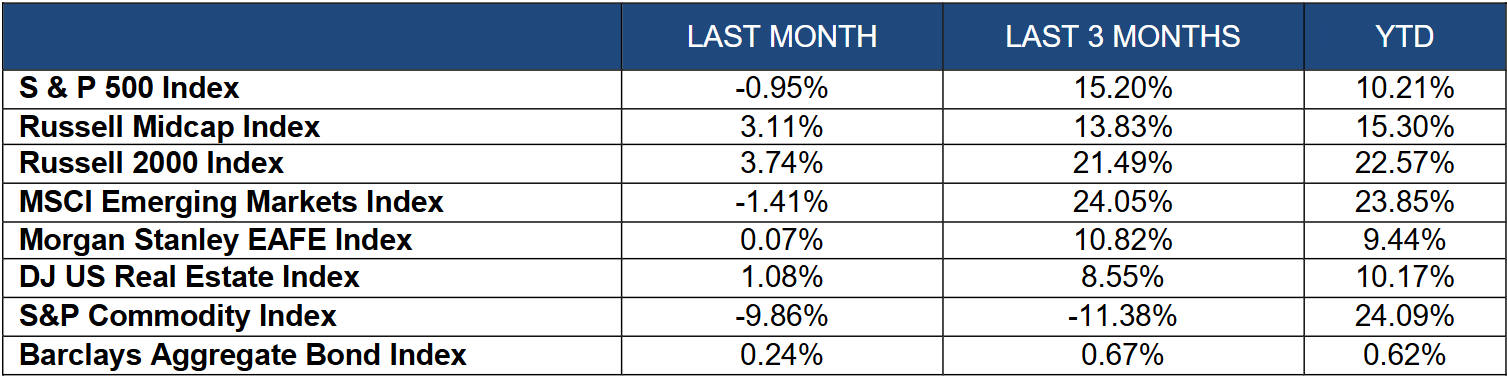
The markets moved higher as concerns over the Middle East conflict subsided. The S&P 500 advanced 15.20% in the second quarter and is now up more than 10% on the year. The Russell Midcap Index also had a great quarter and is now up more than 15% year-to-date. The Russell 2000 Index (Small Cap Stocks) rose by more than 21% and is now up over 22% on the year. Gold dropped by 14% in the second quarter while silver dropped by more than 22%. Bitcoin and other crypto currencies were down double digits in the second quarter.
International stocks continue to offer diversification benefits. The MSCI EAFE Index gained 10% in the second quarter and is up that much on the year. Emerging Markets had a massive quarter by advancing 24%. These index returns were led by Korea’s 74% advancement followed by Taiwan which was up by almost 50%.
Bonds have had such a quiet start to the year. The Barclays Aggregate Bond Index is up 0.62% on the year. The global bond market was up 4.6% in the second quarter and is now up 2.6% on the year. There is a decent chance that we do not see any change in interest rates for the remainder of the year. If this holds true, we expect bond returns to remain flat in 2027.
Economic Review and Outlook
After a decent 2.1% growth rate in the first quarter of the year, economic activity seems to be slowing down. The increase in energy prices slowed consumer spending in the second quarter as higher gas prices reduced discretionary spending. It looks like the second quarter GDP will be around 1%.
The higher tax refunds that lower income households received in the second quarter mainly just got spent at the gas pump. This is causing a K-Shaped economic situation where higher income households seem to be faring well, and lower income households are struggling. This will impact earnings on companies that cater to the middle- and lower-class households.
We continue to be in a low hire, low fire labor market. The unemployment rate is at 4.2%, which is near full employment. The CPI inflation index came 4.2% in May. This is significantly higher than the Fed’s target of 2.0%. A good portion of this increase was due to energy which reversed course in June. The June CPI should drop down to around 3.8% and will drift lower the rest of the year. This means that the Federal Reserve is likely to hold rates steady until the end of 2026.
The Leading Economic Index increased by 0.1% in May to 99.3 following a 0.2% increase in April. Industrial Production increased 0.1% in May after rising 0.9% in April. The Capacity Utilization Rate (which measures how much slack is in the economy) was at 76.2% in May which is still below the long-term average.
Non-farm payrolls rose by 57,000 in June and the unemployment rate fell to 4.2%. Weekly unemployment claims were 215,000 for the week ending July 4, 2026. The 4-week moving average is at 218,750. There are 7.6 million job openings in the U.S. It is important to remember that the unemployment rate is a lagging indicator. We are very much in a slow to hire and slow to fire labor market. Although a weaker economy typically triggers a higher unemployment rate, the massive drop in immigration may keep the labor force thin causing the rate to hold steady.
Manufacturing registered 53.3% on the ISM PMI Index in June. This indicator remains in expansion territory for the 20th month in a row. The New Orders Index came in at 56% which marks the sixth month in a row of growth. The ISM Services Index was at 54.0% in June, which was down 0.5% from May. The Business Activity Index came in at 55.4% which is the lowest reading since September. New Orders for the service sector came in at 55.1% which was 2.2 percentage points below May’s reading.
Consumer spending will continue to be a topic of conversation for economists as they work through the higher energy costs associated with the Middle East conflict. Lower income households will have to curb their spending, while higher income households will need to continue to spend to offset any disruptions. The increase in net worth for many households over the last two years should help keep the economy going for at least this year.
Equity and Bond Markets
We continue to see shifts in sector performance. Non-diversified portfolios could be missing out on what has been happening so far in 2026. After a pull-back in the first quarter, domestic and international equities pushed higher in the second quarter on optimism of a conclusion in the Middle East and earnings growth from AI.
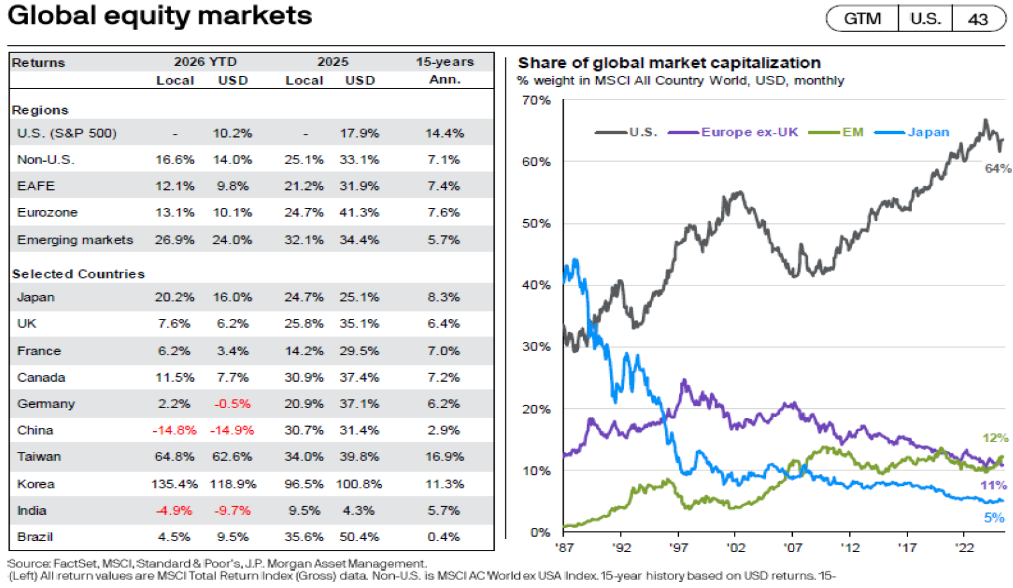
Domestic stocks showed solid returns in the second quarter across multiple asset classes. Growth outperformed value and small companies outperformed large companies. And yet international indexes continue to outperform U.S. equities. Emerging markets are now up roughly 24% on the year and continue to look attractive relative to their long-term valuations. You can see in the chart below that the U.S. now represents 64% of the global market capitalization while we only produce 27% of the global GDP. Meanwhile, the EM market cap is around 12% while they produce 41% of the global GDP
Currency changes can impact international returns. A stronger dollar will detract from international returns while a weaker dollar will enhance the number. So far this year, the U.S. Dollar has posted a 3% gain. Most economists believe that the dollar will fall over the next few years, which should add an additional tailwind for international
equities and foreign bonds.
We think bond prices will hold relatively stable for the remainder of this year as we are not expecting any moves from the Fed. Meanwhile, coupon rates are solid, so bonds still offer an attractive yield and provide diversification benefits to offset the volatility of equities.
Portfolio Management
The Investment Committee continues to monitor the economy, the market, and the portfolio allocations. Our strategy has not changed. We expect continued volatility in the market as we continue to have disruptions in the Middle East. It is also a mid-term election year. Uncertainty in the political environment can increase short-term volatility in equities. However, we do not recommend making big changes in allocations because of Washington.
We will continue to look at ways to diversify the portfolio to try to minimize the downside capture ratio. We are looking at ways to increase the yield of the portfolio while maintaining appropriate risk. It will be important to have an allocation discussion with your planner to make sure that your current allocation matches your investment risk and time horizon.
After three years of double-digit returns, we do expect continued downside volatility. Maintaining an appropriate allocation and diversification will be critical to portfolio performance. While nobody can predict what will happen in the short-term, we believe that long-term investors will be rewarded with good returns if they can just keep a long-
term focus and ignore any of the short-term volatility that is likely to be present in 2026.
Financial Planning
Trump Accounts are the latest type of investment account to hit the scene. These new accounts are for minor children only and were established as a part of the One Big Beautiful Bill Act. Trump accounts are now available. Enrollment is open, so we wanted to highlight what we know and start to explore how Trump Accounts will fit into planning for minor children.
Any child age 17 or younger with a valid Social Security number is eligible to establish a Trump Account. Accounts are managed by a legal guardian until age 18. At age 18, the accounts will transfer to the child’s sole control. Children born in calendar years’ 2025-2028 will receive a starting deposit of $1,000 from the US government. Any child age 17 or younger can establish an account, but only children born in 2025-2028 will receive the initial deposit.
Each year, additional contributions up to a maximum of $5,000 can be invested into each child’s account. Contributions must stop the calendar year a child turns 18. Contributions are made with after-tax dollars, meaning there is no immediate tax advantage to parents, grandparents, or any other individuals who contribute into a Trump account. However, employers can contribute $2,500 pre-tax into accounts. We believe this would work like a pre- tax salary deferral or an additional employer benefit. The $2,500 counts against the $5,000 annual limit. Any contributions made by the Federal government will not count toward the $5,000 limit.
The accounts will grow tax-deferred until the child reaches age 18. At that time, the account will likely be converted to a Traditional IRA in the child’s name and follow the same withdrawal rules as a Traditional IRA. At age 18 funds can be used for education or a first-time home purchase. Funds can also remain in the account to continue growing for retirement.
It was just recently announced that Bank of New York Mellon (BNY) will be in the initial custodian for Trump Accounts. Robinhood will work with BNY and the Treasury department to develop an app to service the accounts.
So, how do Trump Accounts fit into long-term planning? It depends on the ultimate goal.
If paying for higher education costs is the main goal, a 529 Plan is still likely the best investment vehicle. Many states offer immediate tax advantages for contributions into 529 plans. Funds grow tax-deferred and can be used tax-free on qualified education expenses. If a child has money left in a 529 after their higher education is complete, there is now even a way to roll over funds into a Roth IRA for that child to kickstart their retirement savings.
Another way to save for minor children is a UTMA account. This is an individual account set-up for the minor, with a parent or guardian named as a custodian on the account. The custodian stays on the account until the child reaches the age of majority, which is age 21 in many states. This type of account typically works best if the goal is to create a nest egg for the child to use as they see fit. Typical uses of this type of an account would be a downpayment on a home, to start a business, car purchase, etc. There are no annual caps on how much can be contributed to an UTMA account, so this is also a way that families can gift large amounts to the next generation.
Again, Trump accounts are new, and we still need clarity on how they will operate. At this early stage, we believe they should be viewed as way to kick-start retirement savings for children. The right combination of savings into each type of investment account will vary from family to family.
You can enroll in a Trump account by filling out Form 4547. This form is available on trumpaccounts.gov. The website says to anticipate hearing from the Treasury Department when it is time to activate the account.
Company News
At Galecki Financial Management, we strive to deliver Worry-Free Wealth Management. We do this by hiring quality individuals who can deliver exceptional service to our valued clients. We are quite blessed to have a growing business with so many great new clients. To service all our clients effectively, we have hired three new employees.
Emily Powell: Emily is our new Asset Management Specialist. She works together with the Advisory teams to manage back-end operations and streamline internal processes. She will probably be contacting you regarding your contributions or distributions. Emily enjoys spending time with her boyfriend and two sons Grayson and Ethan. She is also a famous equestrian rider and teacher. She offers lessons to people of all ages. If you email Emily about potential lessons, please ask her about the special discounted rate for Galecki clients.
Grace Hammond: Grace is a new Staff Financial Planner and will be working directly with Melanie Colwell, CFP®. Together, they will work to deliver quality plans tailored to the unique situation for each client. She will be in charge of the behind-the-scenes work for Melanie’s clients. Grace is active in her church in Roanoke and loves playing pickleball. She would one day like to play on the Major League Pickleball tour!
Kyle Arnold: Kyle is a new Staff Financial Planner and will be working directly with Kevin Chandler, CFP®. Kyle will work to support Kevin in the planning process for his clients. Kyle is a former teacher, is married to his wife Sammie and has two boys, Louie and Henry. Kyle still officiates high school athletics. He also enjoys playing pickleball and he said he likes to walk to the local courts in the evening and show everyone how the game should really be played. He said he had an Ernie winner the other night, but I am questioning the level of his competition. Feel free to email Kyle and challenge him on the court.
If you would like to schedule an appointment with a CERTIFIED FINANCIAL PLANNER® Professional, please visit galecki.com